
Mumbai terror attack accused Tahawwur Rana has moved an 'emergency application' with the United States Supreme Court against his extradition to India, claiming that he will be tortured there since he is a Muslim of Pakistani origin.

To a question, Headley further clarified that he had informed the NIA that 'this woman (Jahan) was an Indian and an LeT operative' but could not explain why this was not recorded in his statement.

The CIA released 4,70,000 additional files seized in May 2011 when US Navy SEALs burst into the Abbottabad compound and shot dead Laden.

Pakistani-origin Canadian businessman Tahawwur Rana, sought for his involvement in the 2008 Mumbai terror attacks, has approached a US court for a status conference after waiting for an order on his extradition to India for more than 20 months.
A US court in California has dismissed a status conference motion moved by imprisoned Pakistani-origin Canadian businessman Tahawwur Rana, who is sought for his involvement in the 2008 Mumbai terror attack, stating that it anticipates a ruling on his extradition to India within 30 days.

'The Americans never or hardly give complete information, only information that directly affects them is shared.' Indian intelligence agents challenge The Siege's version of the 26/11 attacks in conversations with Vicky Nanjappa.
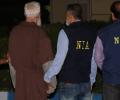
Tahawwur Hussain Rana, a key accused in the 26/11 Mumbai terror attacks, was brought to India on Thursday after being "successfully extradited " from the US, the National Investigation Agency (NIA) said. The 64-year-old Canadian citizen of Pakistani origin landed in Delhi in a special plane on Thursday evening, ending days of speculation of when and how he will be extradited, officials said. The NIA said in a statement that it had secured the successful extradition after years of sustained and concerted efforts to bring to justice the key conspirator behind the 2008 mayhem that claimed 166 lives. Rana is accused of conspiring with David Coleman Headley alias Daood Gilani, and operatives of designated terrorist organisations Lashkar-e-Taiba (LeT) and Harkat-ul-Jihadi Islami (HUJI) along with other Pakistan-based co-conspirators, to carry out the the three-day terror siege of India's financial capital.

Filing the Writ of habeas corpus through his attorney, Rana, 62, challenged his extradition by the Government of India. Rana's extradition would violate the United States-India extradition treaty in two respects, his attorney argued.

The family and the lawyer of Ishrat Jahan, who was killed in an alleged fake encounter in Gujarat, on Thursday raised questions over David Coleman Headley's testimony that she was a Lashkar-e-Tayiba operative, saying this was for the "political benefit of some big people" whose names have been "besmirched."

'India has established probable cause to prosecute him for his role in terrorist attacks that resulted in 166 deaths and 239 injuries'

If the radical Islamic movement had been largely peaceful, Headley would have probably found another way to ensure real life excitement.' 'But I really do believe that his relationship with radical Islam is real. Very real.' 'It was a match for his desires.'

Pakistani-American terrorist David Coleman Headley on Thursday exposed how Inter-Services Intelligence and Lashkar-e-Tayiba majorly funded terror operations in India.

Here are the highlights from the Lashkar terrorist's deposition on Day 4.
Tahawwur Rana, accused in the 2008 Mumbai terror attacks, has renewed his application to the US Supreme Court seeking a stay of his extradition to India. The Supreme Court will hear the application next month. Rana, currently detained in Los Angeles, claims his extradition would violate US law and expose him to torture in India due to his health and Muslim background. The US government has denied these claims and authorized his surrender to India, citing the Extradition Treaty between the two countries. The Supreme Court's decision will determine if Rana will face justice in India or remain in the United States.

Deposing for the third day after his cross-examination began on Wednesday, Headley said Yousuf Raza Gilani, former Pak PM, had visited his house after the 26/11 attacks.
In a huge setback to Tahawwur Hussain Rana, a United States court has ruled that the Pakistani-origin Canadian businessman could be extradited to India where is wanted for his involvement in the 2008 Mumbai terror attack carried out by Pakistan-based Lashkar-e-Taiba terrorists.
Testifying before a Mumbai court for the second day on Tuesday, Pakistani-American terrorist David Coleman Headley said LeT had planned to attack Indian defence scientists at the Taj Mahal Hotel in Mumbai and that he was asked by Pakistan's ISI to recruit Indian armymen to spy for them.
Tahawwur Rana, accused in the 2008 Mumbai terror attacks, has been extradited to India after the US Supreme Court denied his last-ditch effort to avoid being sent back. Rana, a close associate of David Coleman Headley, another key conspirator in the attacks, was expected to be extradited "shortly" after his legal appeals failed. This decision comes after a multi-agency team from India traveled to the US to complete all necessary paperwork and legalities with the US authorities. Rana's extradition marks a significant development in the pursuit of justice for the victims of the Mumbai attacks.
The 59-year-old Rana, a childhood friend of David Coleman Headley, was re-arrested on June 10 in Los Angeles on an extradition request by India for his involvement in the 2008 Mumbai terror attack in which 166 people, including six Americans, were killed.
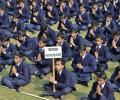
In the wake of the terror attack on a school in Pakistan's Peshawar, Centre has asked all states to beef up security particularly in educational institutions.

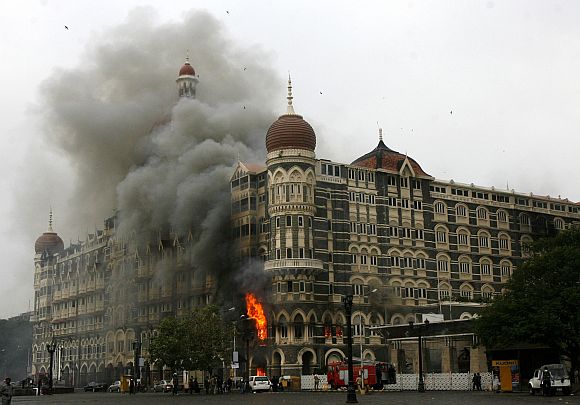
Ten terrorists of Pakistan-based Lashkar-e-Taiba carried out 12 coordinated shooting and bombing attacks lasting four days across Mumbai. At least 166 people, including six Americans and nine terrorists, were killed and over 300 others were injured in the attacks which began on November 26, 2008.

The United States has approved the extradition of Tahawwur Rana, accused of involvement in the 2008 Mumbai terror attacks, to India. The decision was announced by President Donald Trump during a joint press conference with Prime Minister Narendra Modi in the White House. India is currently working on the logistics of Rana's surrender and extradition, with several final steps to be completed before he is sent back to India. The joint statement issued by India and the US during Prime Minister Modi's visit reaffirmed their commitment to fighting terrorism and eliminating terrorist safe havens. The leaders also called on Pakistan to bring to justice the perpetrators of the 26/11 Mumbai and Pathankot attacks. Rana, a Canadian national of Pakistani origin, is currently lodged at a metropolitan detention center in Los Angeles. He is associated with Pakistani-American terrorist David Coleman Headley, one of the main conspirators of the 26/11 attacks.
David Coleman Headley pens down his life as a terrorist and his turn towards extremism in his new memoir.

A federal United States court has allowed Pakistani-origin Canadian businessman Tahawwur Rana time till November 9 to file a motion against his extradition to India to face a trial in the 2008 Mumbai terror attack.

United States Assistant Secretary of State for South and Central Asian Affairs Robert Blake, while briefing reporters on the meeting between Secretary of State Hillary Clinton and External Affairs Minister S M Krishna on the sidelines of the 65th United Nations General Assembly in New York, said the issue of direct and complete access to Pakistani American and Lashkar operative David Coleman had not come up at all at these talks.
Rana's extradition is barred under Article 6 of the United States-India extradition treaty with India because he has previously been acquitted of the offences for which extradition is sought, and under Article 9 of the Treaty because the government has not established a probable cause to believe that Rana committed the alleged offences, his attorneys argued.

Both Major Iqbal and Major Pasha are shown as wanted accused in the charge sheet filed by the city police's crime branch in the case.

The internet services giant wanted to cover most of the Indian territory through the Google Street View.
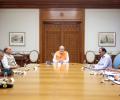
'The government has to explain (to the army, air force and navy chiefs) whether they want a punitive strike, a deep punitive strike, or whether they want limited war or an all-out war, will it be a circumscribed war or will it be a shallow attack along the border.'

Lashkar-e-Tayiba and the Al Qaeda were convinced that 26/11 attack masterminds Hafiz Saeed and Zakiur Rehman would face only "superficial" action from the Pakistani authorities and within months plans were afoot for another terror strike in India, Pakistani-American terrorist David Coleman Headley said on Saturday.
A United States court has denied the writ of habeas corpus filed by Pakistani-origin Canadian businessman Tahawwur Rana, paving the way for US Secretary of State Antony Blinken to issue a certification for him to be extradited to India where he is sought for his involvement in the 2008 Mumbai terror attacks.
A Delhi court on Saturday took cognisance of the National Investigation Agency chargesheet against Pakistani-American David Headley Coleman and eight others for allegedly carrying out several terror attacks in India.
'Headley's testimony indicates to what extent the Pakistan government and its proxies can go to destroy not only Indian scientific talent but also international expertise.'
Overriding the Biden administration's appeal, a US court has ordered a stay on the extradition of Pakistani-origin Canadian businessman Tahawwur Rana, to India where he is facing a trial for his involvement in the 2008 Mumbai terror attacks.
Describing Rana as a flight risk, the US government opposed his release on bail, arguing that if he were to flee to Canada, he may escape the possibility of a death sentence in India.

The Lashkar-e-Tayiba operative also revealed about his training while he deposed in front of a Mumbai court via video link.
'Amid the different versions of truth on the Ishrat case, what is certain is that Ishrat's mother Shamima Kausar, who has continued to maintain that Headley's confession was nothing but an attempt by powerful people to save themselves in the case, is unlikely to find a closure anytime soon.'

Rana, 59, a childhood friend of David Coleman Headley, was recently released from jail on compassionate ground after he told a US court that he has tested positive for the COVID-19.

India's National Investigation Agency is probing into his role in the 26/11 attacks carried out by Pakistan-based Lashkar-e-Taiba terrorists in 2008.

'The Ishrat encounter was neither genuine, nor fake. I believe it was a 'controlled killing,' says Shekhar Gupta.
